
Modern medicine plays an important role in managing vitiligo by helping regulate autoimmune activity, stabilize disease progression, and support skin repigmentation. Modern Medicines for Vitiligo in India include evidence-based topical and oral treatments tailored to the severity, activity, and pattern of the condition. Choosing the appropriate Vitiligo Medicine in India depends on factors such as the patient’s skin condition, extent of white patches, and response to treatment. As part of a comprehensive treatment approach, these medications may be combined with phototherapy, nutritional support when needed, and healthy lifestyle practices to improve treatment outcomes. This integrated approach allows vitiligo specialists to provide personalized care, support repigmentation, and manage the condition according to each patient’s individual needs.
Modern Medicines for Vitiligo in India include scientifically supported topical and oral treatments that may help regulate the immune system’s activity against pigment-producing cells (melanocytes). As part of Advanced Vitiligo Treatment in India, these therapies aim to control disease progression, support skin repigmentation, and improve overall skin health. Treatment options are selected according to the severity, activity, and extent of vitiligo. These therapies are designed to:
Common treatment options for vitiligo may include topical corticosteroids, calcineurin inhibitors, JAK inhibitors, antioxidant supplements, and carefully selected oral medications based on disease activity and individual patient needs. Vitiligo Treatment Cost in India varies depending on the type of medication, severity of the condition, treatment duration, and additional therapies recommended by the dermatologist.
Topical Steroids
Topical Calcineurin Inhibitors (Non-Steroid)
JAK Inhibitors
Other Immunosuppressants and Add-Ons
Modern medical therapy may be recommended for:
Newly Diagnosed Patients
Individuals who have recently noticed white patches and require early intervention to prevent progression.
Active Vitiligo Cases
Patients experiencing rapid enlargement of existing patches or the appearance of new depigmented areas.
Localized Vitiligo
People with small to moderate areas of pigmentation loss that can respond well to topical treatments.
Patients Undergoing Combination Therapy
Individuals combining medicines with phototherapy, excimer laser treatment, or integrative treatment plans.
Children and Adults
Treatment plans can be customized according to age, disease activity, and medical history.
Vitiligo is considered an autoimmune condition in which the body’s immune system mistakenly attacks melanocytes, the cells responsible for producing skin pigment. Choosing the Best Medicine for Vitiligo in India depends on the severity, location, and activity of the condition, with dermatologists recommending suitable treatments to help control disease progression and support skin repigmentation.
Modern medications work by:
Immune Regulation
Reducing abnormal immune activity that damages pigment cells.
Inflammation Control
Decreasing inflammatory signals that contribute to disease progression.
Melanocyte Protection
Creating a healthier environment for surviving melanocytes.
Repigmentation Support
Encouraging pigment cells to regenerate and migrate into affected skin.
Enhancing Phototherapy Results
Improving the effectiveness of Narrowband UVB and Excimer Light treatments.
Before starting treatment:
During Treatment
After Improvement
Every patient responds differently.
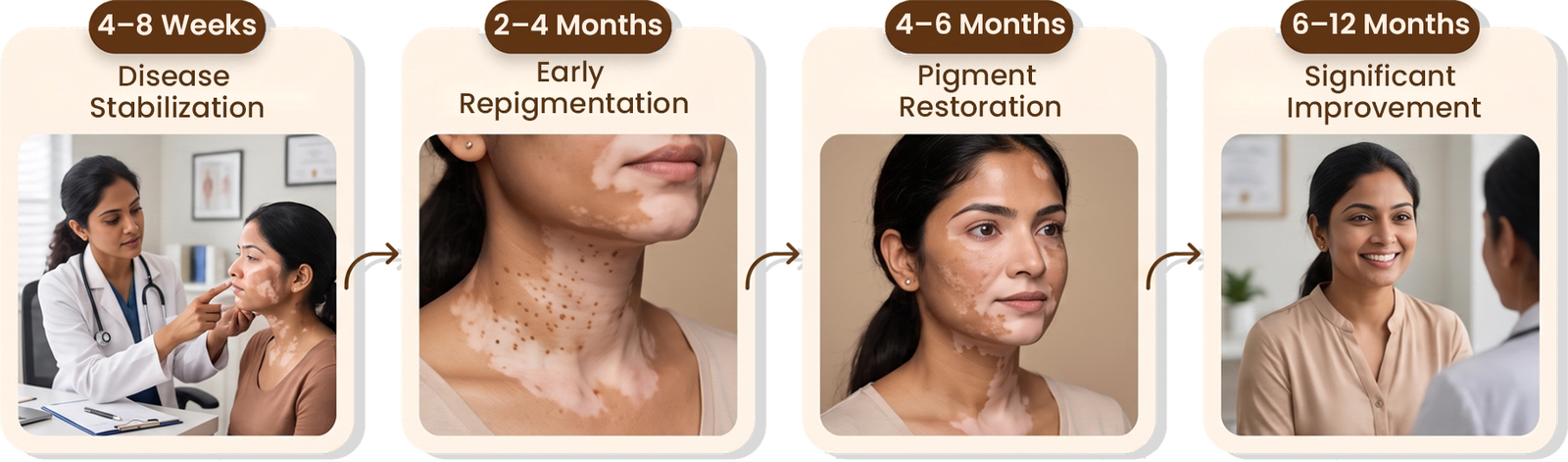
During treatment, you may notice:
Initial Stabilization
The first goal is stopping the progression of vitiligo.
Early Pigment Dots
Tiny brown pigment spots may appear within white patches.
Gradual Repigmentation
Pigment slowly spreads outward and fills affected areas.
Improved Skin Uniformity
Over time, treated areas may blend more naturally with surrounding skin.
First 4–8 Weeks
2–4 Months
4–6 Months
6–12 Months
Results vary based on disease duration, location, skin type, and treatment adherence.
Modern vitiligo treatments are generally well tolerated when used under medical supervision.
Possible side effects may include:
Topical Medications
Oral Medications
Individual Variation
Not every patient experiences side effects, and most are manageable with proper guidance.
The cost of vitiligo treatment depends on:
Because every case is different, a personalized consultation is necessary to determine the most suitable treatment plan and associated costs.
Factor | Ayurveda | Modern Treatments |
Approach | Holistic, natural | Medical, targeted |
Speed | Slow | Faster in many cases |
Evidence | Traditional + limited clinical data | Strong clinical evidence |
Best use | Supportive therapy | Primary treatment |
Side effects | Generally mild | Depends on therapy |
Modern medicines are often most effective when used as part of a comprehensive treatment roadmap rather than as a standalone solution.
Book a Professional Assessment
A detailed evaluation helps determine:
Receive a Personalized Roadmap
Your treatment roadmap may include:
Begin Early
Early treatment often provides better opportunities for disease control and repigmentation.
There is currently no guaranteed permanent cure for vitiligo. However, modern treatments can effectively control disease activity and promote significant repigmentation in many patients.
Some patients may notice early improvements within 2–3 months, while substantial repigmentation often requires 6–12 months of consistent treatment.
Many modern vitiligo treatments can be used safely in children under specialist supervision and with age-appropriate treatment plans.
Stopping treatment without medical guidance may increase the risk of recurrence. Maintenance therapy is often recommended.
Yes. Many patients achieve better outcomes when medications are combined with Narrowband UVB or Excimer Light therapy.
Response varies depending on patch location, disease duration, and individual factors. Facial areas often respond more favorably than hands and feet.
Not necessarily. Treatment duration depends on disease activity, response, and long-term maintenance requirements.
One of the primary goals of modern medical treatment is to stabilize vitiligo and reduce the formation of new depigmented patches.
It’s time to take control of your skin health! Booking your appointment is easy and fast. Choose a time that works for you and our dermatology experts will be ready.